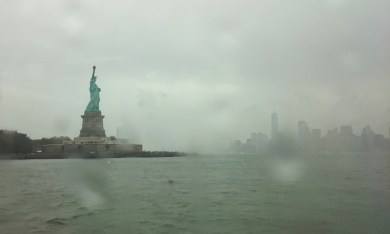
On a grey, cold day in October, I boarded a ferry outside the gates of Castle Garden, at the tip of Manhattan. Looking out the ferry window, my parents and I could see a misty Statue of Liberty. From this vantage, the scene would have looked similar to one more than 100 years ago when three of my four grandparents[1] arrived in the United States via Ellis Island.
The St. Paul, the Pennsylvania and the Kroonland carried my ancestors through the Narrows and within sight of the famous statue. After the ships passed quarantine inspection, they docked at the Hudson River piers and citizens and most 1st and 2nd class passengers disembarked. Immigrant steerage passengers passed through customs and then boarded ferries, taking them to Ellis Island for medical and legal inspection. They entered the main floor past stacks of luggage, and climbed stairs to the Inspection Room [2].

Across this floor and through these lines walked
- my maternal great-grandparents, my great-grandmother four months pregnant with her first child, my grandfather.
- my paternal great-grandmother, shepherding four children under the age of 10, including my five-year old grandfather.
- my maternal grandmother, three months old and bundled in the arms of her mother, along with her father and older half-sisters.
My maternal great-grandparents passed through inspection, and with $10 and a dream, headed into the cacophony of Suffolk Street and a tenement on the Lower East Side of Manhattan.
My paternal great-grandmother and her children already had train tickets to their final destination of St. Louis, and after passing inspection would have taken a ferry to the railroad, probably out of New Jersey.
My infant grandmother, her parents and half-sisters also had train tickets to their final destination, however they were detained for several hours over concern that the group might be L.P.C., or Likely Public Charge. They ate dinner (lunch) in the detention cafeteria before it was determined that the group had not $10 but actually $45 dollars and the capacity to continue the journey by train to St. Louis.

My parents in the Ellis Island Registry Room.
The visit to Ellis Island brought me and my parents back to the beginning of our immediate family’s life in the United States. Our Ellis Island immigrants comprised just 12 of the more than 12 million immigrants who passed through Ellis Island during its years of operation (1892-1954).
What is your immigrant story?
- Including my maternal grandfather in utero.
- Detroit Publishing Co., Copyright Claimant, and Publisher Detroit Publishing Co. Inspection room, Ellis Island, New York. [between 1910 and 1920] Image. Retrieved from the Library of Congress, https://www.loc.gov/item/det1994018383/PP/. (Accessed November 03, 2016.)
 eastern european mutt