Uncategorized

A Tale From the Mixed-Up Files of the Civil War Pension Records

As a young reader, I loved the book From the Mixed-Up Files of Mrs. Basil E. Frankweiler by E.L. Konisburg, and the novel came to mind the past few days as I sought out a Civil War Pension file.

It started out as a simple request – could I locate the file and scan the contents for a researcher in Texas? He provided me with the T288 index card for Walter Vaughn, who had been a member of the 74th Indiana Infantry, Company H, and the 1st Regiment U. S. Veteran Volunteer Engineers, Company C, during the Civil War.

I took the application and certificate numbers from the index card, which dated to 1880, when Walter Vaughn applied for an invalid pension, and filed a search request at the National Archives. Usually, retrieval from the stacks takes about an hour. I went up to the reading room, but received the dreaded white “return request” slip. The file was not located. My mistake, I should have also checked the T289 organizational index for the same soldier.

Pulling up the T289 index card for Walter Vaughn began what one NARA staffer dubbed, “a rabbit hole” of names, dates and files. On this card, the clerk, writing almost 100 years ago, wrote to also reference the files of John U. Hurst of Ohio and Daniel S. Witmer of Indiana. I emailed the researcher, asking if he wanted me to continue, and if he knew either of these additional surnames. He knew the surname Witmer as the maiden name of Walter Vaughn’s wife, Permila.

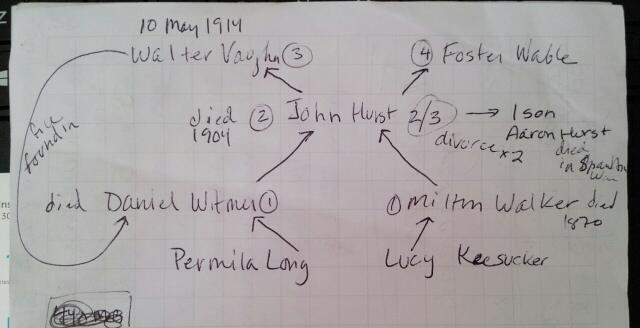
John U. Hurst's T289 CardA staffer helped me as I pulled up information on the new names, which resulted in even more “see also” notations: Foster Wable and Aaron Hurst. Who were all these men and how did they all connect? Papers were scattered across the staffer’s desk, and I sketched a flow chart to see if that provided any clarity. Meanwhile, two additional staffers joined in the discussion. One noted that on Aaron Hurst’s card was the name of his mother: Lucy Wable. Lucy? I thought we were looking for Permila! I assembled a small stack of file requests, and the staffers made me promise to give them the full report of what I found.

Based on the flow chart and dates on the index cards, I guessed that the answer might be found in Foster Wable’s file. The file was at least three inches thick. I dug in – pages and pages on Foster Wable’s application for a pension, even more pages on his wife Lucy’s application for a widow’s pension, and yet even more pages on Lucy’s application for her son Aaron Hurst’s benefits. Lucy’s marital history partially explained things: Foster Wable was her fourth marriage and third husband. Her second marriage was to John Hurst, and they had a son, Aaron. John and Lucy divorced, then remarried, then divorced again. I found a touching note from the nurse who cared for Aaron Hurst as he lay dying in the Philippines during the Spanish-American War, but not one mention of Walter Vaughn or Permila. The filed turned out to be a total red herring.

Next up, Daniel Witmer’s file, another thick set of papers. Again, multiple pages of applications for pension, but most of it was focused on Permila J. Long and her widow pension applications, and rejections. Permila married Daniel Witmer in 1866; he died in 1892. She married John Hurst in 1900; he died in 1904. Finally, she married Walter Vaughn. Marriage and relationship flow chart 2This explained the connections between the women and the men, and I found Walter Vaughn’s pension files after all the paperwork for Daniel Witmer. This allowed me to complete my client’s request, but it didn’t satisfy my curiousity – why was Walter Vaughn filed with Daniel Witmer? If there was a widow’s pension, it would have been filed as such, but these files were for soldier’s pensions.
I had one more file to go, John U. Hurst. Ultimately, I did locate the “Rosetta stone” for the files, a piece of paper in John Hurst’s file, with the notation from a clerk written on 2 December 1918:

There is in the blue jacket several independent claims which should be separated and sent to their proper places.Image

Do you have any old letters or documents? Vol. 1

When I started working on my family’s history, I reached out to cousins of my parents‘ generation, interviewing them, asking them questions, and more questions. I also requested copies of photos that they had, looking on the backs of the images for clues. And I asked if they had any old letters or other documents.

One of my dad’s first cousins reponded to my document query with a note

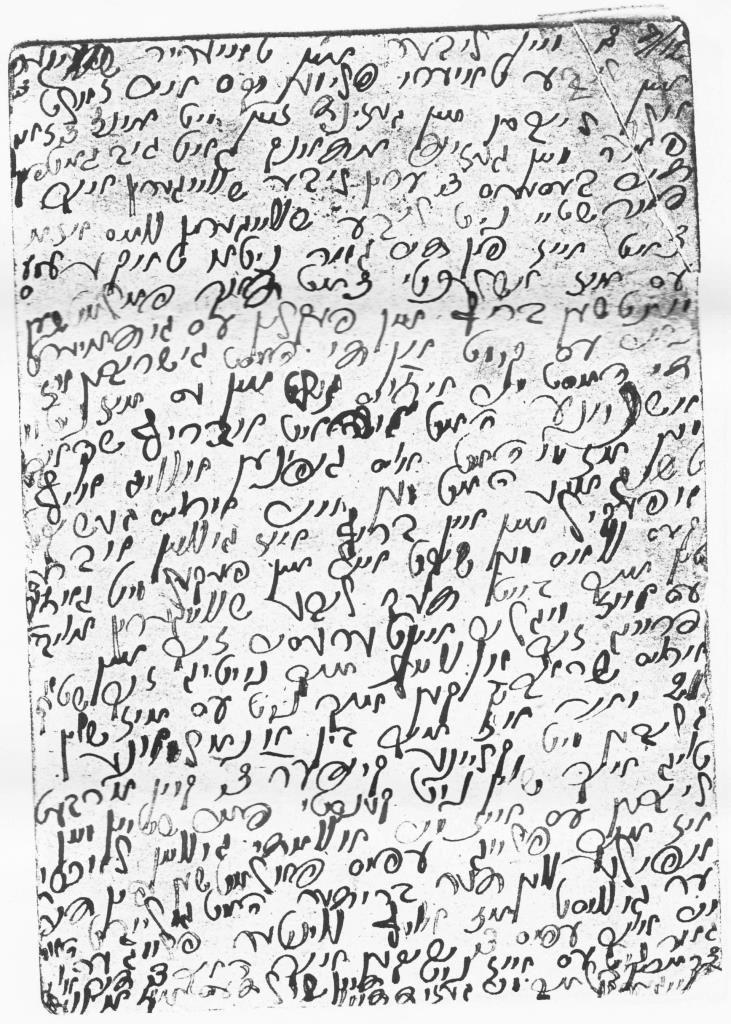
[Your grandmother] sent me some correspondence from 1940 from family in the Ukraine which apparently requested some  money or clothing material or both. The correspondence is written in some kind of script, possibly Yiddish. I once had attempted to get someone to try to translate it, but not very successfully. However, I was told that the letter and a postcard were from “Sure” (which I was told meant Sarah) Mordche-Leibovna Schnaider ….. She may have been a sister-in-law of [my grandmother], or possibly a sister of Samuel.

Wow. 70-something year old letters from a heretofore unknown relative. This cousin was kind enough to scan all the letters, envelopes and bit of paper. I had them translated from Yiddish, and they were an eye-opener.Yiddish postcard August 1940

The letters detail requests for money and goods to be sent to Sore Mordeche Leibnova Schnaider on Rakovaya Street in Medzhibozh, Podolsky Gubernia [present-day Medzhybizh, Khmelnytskyi Oblast, Ukraine].  Sore addressed the envelopes in English, wrote the return address in Cyrillic, and the text of the letters in Yiddish, indicating that she had the ability to write, and possibly understand, at least two languages.

Comparing the data in the letters along with other family information, I determined that Sore was a sister to my great-grandfather.

Meanwhile, Sore’s sister-in-law responds to the requests, sending both a money order and a package of wool suit and coat fabrics, but the letters indicate the package did not arrive.

According to the translator, the letters sound pleading. A widow of 21 years, raising her children on her own, the notes seem to indicate a woman a little desperate and forgotten at a time when most of Europe is moving closer to chaos. The letters were sent from March through December 1940. Whether she sent additional letters is unknown. The Nazis arrived in Medzhibozh on 8 July 1941, placing all the Jews in a ghetto. The ghetto was anihiliated beginning on 22 September 1942, with the liquidation lasting three weeks.

Why Sore chose not to leave Russia, or if she had a choice, is unknown. Her fate, and the fate of her children are also unknown. I have initiated an International Tracing Service search through the United States Holocaust Memorial Museum. Perhaps someday, I will have the answer.

Maps!

The previously planned blog post has been derailed by maps. 20,000 maps, to be precise. The Lionel Pincus and Princess Firyal Map Division of the New York Public Library released more than 20,000 cartographic works as high resolution downloads into the public domain. Property maps. Cemetery maps. Bird’s eye view maps. New York, New Jersey, the Mid-Atlantic. 700 maps of the Austro-Hungarian Empire. More, more more! It’s a rabbit hole of maps!

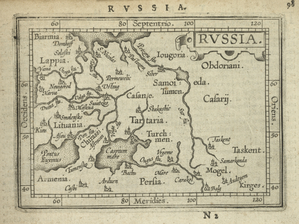
Check out this 1603 map of Russia by Abraham Ortelius (1527-1598) updated by Micheal Coignet, “mathematitian of Antwarpe.”

Russia. Digital ID: 1632225. New York Public Library

More on maps as a tool for genealogy coming soon.

Wiki Trees and Shaking Leaves: A Cautionary Tale

Crowdsourcing a tree can be a fun diversion. It can also work. The algorithms that provide hints to an online tree on Ancestry.com, for instance, can be useful. Connecting with someone researching a common ancestor can break down brick walls and build up family connections. But sometimes those algorithmic hints can lead you astray.

Mordeche Hirsh Polinsky is a great example. Mordeche, also known as Mordecai and Max, had seven children. He had at least four brothers.  His brothers also had many children. Online, there are numerous versions of the family tree, and almost all of them have the same mistake.

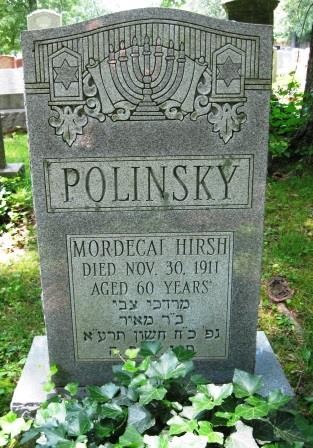
Photograph of headstone of Mordecai Hirsh Polinsky

©Renée K. Carl

Mordeche Hirsh Polinsky did not die in 1911.

Yet, the animated leaf keeps sending out hints that he did. Why? Findagrave.com has uploaded a photograph of Mordecai Hirsh  Polinsky’s headstone at Beth Hamedrosh Hagadol Cemetery which clearly shows a death date of 30 November 1911. Same thing with Billiongraves.com. The headstone must be correct – the family placed it there and it’s inscribed in stone, afterall.

The headstone is wrong.

Two other sources offer information that conflict with the headstone. The St. Louis Post-Dispatch printed burial permits in the newspaper, regardless if the family could afford to purchase an obituary. On 2 December 1910, the Post-Dispatch announced a burial for “Max Polinsky.” At first glance, they do not appear to be the same person, however, Max is a known Americanization of the name Mordeche, and Max was the name Mordeche used for the 1910 Census.

The second source is a death certificate for Max Polinsky. The death certificate gives the date of death as 30 November 1910. The address on the certificate matches a known address for the family. The informant on the death certificate is Max/Mordeche’s son “P. Polinsky” and his full name was signed iMordecai Hirsh death certificaten Yiddish: “Pincus Polinsky.” The burial took place on 30 November 1910 at Hamedrosh Hagadol Cemetery, the same cemetery as the headstone in the photos. The name of Max’s father listed on the death certificate is “Meyer,” the same as what is written in Hebrew on the headstone. The newspaper and the death certificate indicate a date of death in 1910, but the headstone has 1911.

Which is the correct year? 1910.

On a trip to St. Louis, I spoke with the executive director of Beth Hamedrosh Hagodol. We walked together in the oldest part of the cemetery, where Mordeche Hirsh Polinsky is buried. I asked him about the stone and told him about the conflicting dates. He smiled, and explained that the stone in the photograph is not the original one. It was replaced, probably in the 1950s, as the old stones were deteriorating from age and weather. The original cemetery records from 1902–1937 were destroyed in a fire. The mistake could have been misreading the old, crumbling stone when creating the new one, or misinformation from the family.

Is a year difference a big deal? The Genealogical Proof Standard requires both a “reasonably exhaustive search” as well as a “resolution of any conflicting evidence,” so in this case, to meet the standard means to examine resources other than the headstone. Which leads to the conflicting evidence, and sorting out the proper conclusion.

So think twice before hitting “accept” on that shaking leaf, or merging a tree with another. Better yet, get out a rake, pile up the leaves, and be prepared to put many of them on the compost pile. It will avoid a small mistake, like the wrong year being added to the tree, or a big one, like the wrong person. The internet has revolutionized genealogy, but the hard work of proof remains just that, work.

What I’m Reading: Genealogy Standards, Crowdsourcing & Math

An interesting confluence of topics and ideas has emerged in some recent articles I’ve read. While I was working my way through the December 2013 issue of the Association of Professional Genealogists Quarterly, The New York Times published A.J. Jacobs opinion piece, “Are You My Cousin?,” and then a client pointed me to the blog post at Wait But Why titled “Your Family: Past, Present, and Future.”

What’s the connection? On the one side, it’s the Association of Professional Genealogists’ series of articles focusing on the five elements of the Genealogical Proof Standard:

•    a reasonably exhaustive search;
•    complete and accurate source citations;
•    analysis and correlation of the collected information;
•    resolution of any conflicting evidence; and
•    a soundly reasoned, coherently written conclusion.

On the other, it’s using sites like WikiTree and World Family Tree to search for famous connections, and A.J. Jacobs learning that he is related to former New York Mayor Michael R. Bloomberg because Bloomberg is his “wife’s great-uncle’s wife’s first cousin once removed’s husband’s uncles wife’s son’s wife’s first cousin once removed’s husband’s brother’s wife’s nephew.” Got all that? These trees, like other crowdsourced Web offerings like Wikipedia, can be convenient and helpful tools, but they also have inherent traps. Records and documentation can be lacking, assumptions can be made, and tree branches might end up being spliced together in some unlikely ways.

In the middle stands the mathematics, along with graphs and drawings by Wait But Why that explain that yes, we are all cousins, somehow, since we each have 128 fifth great grandparents. Or, on average in the US, more than 300 4th cousins. That’s a pretty wide canopy on a family tree.

It can be a great conversation starter to be able to trace back 10 generations or have someone famous in your tree. I’m not dismissing crowdsourcing as a tool for genealogy – it can be incredibly useful. I’ve contacted A.J. Jacobs to see if he is my cousin, but for me, and my work as a genealogist, I’m going to check for some documentation. I know that research will not always be able to meet the Genealogical Proof Standard, but I will strive to reach it.

Stay Up All Night to Get Lucky

If you’re like me, the ear-worm music of Daft Punk is back in your head after their recent Grammy win. Which has me thinking about genealogists and researchers who say, “I got lucky” when a document emerges that helps things fall into place. I’m certainly guilty as well, so I have to remind myself that it’s not luck. With so many records online, one clue can lead to another, and another, then a search query tweaked and – voila. That “fall into place,” however, can be at the expense of dinner, or a bedtime, or any number of other responsibilities. Genealogists stay up all night, but it’s not about getting lucky.

Sometimes, though, ancestors were in the right place at the right time. Here’s an example I’ve been researching: the client knew Anna Jenkins’ and Wolf Fagen’s approximate birthdates; that they were born in Russia; and lived in both Worcester, Massachusetts and Philadelphia, Pennsylvania.

One of the goals of the project was to determine where in Russia Anna and Wolf were originally from, so I started looking for their ship manifest, a document that bridges the Old and New World.

I located a 1907 manifest for Wolf and Annie Fagen. The ages matched what was known, and their final destination was Philadelphia. I noted that while their birthplace was listed as “Wilna,” their last permanent residence wasn’t somewhere in “Russia,” but Liverpool, England. Those were clues I decided to investigate at another time.

Next up was to determine how long Anna and Wolf lived in Philadelphia. That meant looking for the 1910 US Census, which would show how long they had been married; if they had any children; and their date of arrival in the US. I looked for them without any results, even looking at the address where they had first lived with an uncle. I expanded the search to Massachusetts, still no hits. I reviewed what I knew, and decided to try a “friends and family” approach by looking for possible relatives of Anna and Wolf in Liverpool in the 1911 England Census.

What I found was unexpected: Anna and Wolf Fagen living in Liverpool in 1911! They had two children, one born in Philadelphia, and one born in Liverpool. That narrowed the time frame down to when the Fagens returned to England from the US.

But there were children known to be born in Massachusetts, which meant at least one more trip across the pond. I returned to examining ship manifests, and found that the Fagens, now with three children, one born in Philadelphia and the two younger ones born in Liverpool, traveling to Boston in 1912. Their final destination: Worcester, to the home of Anna’s father.

I have a lot more work to do in researching and writing this family’s history, but I’ve already learned a lot, and I’m grateful they were in the right place (England) at the right time (1911), so an enumerator could capture their demographic details.

Touching History

Viewing Widow's Pension File at the National Archives

Viewing Widow’s Pension File at the National Archives

Being a researcher and living in Washington, DC has its advantages, with the National Archives’ depositories of documents accessible to the public. With so much available online, it is easy to forget the feeling of holding a century-old document in one’s hand.  The paper might be yellow, brittle or creased, but in addition to the information it possesses, that piece of paper is a connection to the past. An ancestor’s hand passed across that same piece of paper.

A recent project had me accessing several record sets at the National Archives. Since my client also lives in DC, I brought him with me to the research room to view his third great-grandmother’s application for a Widow’s Pension after the death of her husband, a member of the U.S. Colored Infantry during the Civil War. The Widow’s Pension files can be a genealogical treasure trove, but in this case, they were more: connecting the Civil War to the present day.

Eastern European Mutt

Cab drivers like to ask me where I’m from. I always respond, “Chicago.” Then they say, “No, where are you from?” I know what they are getting at – what is my ancestry, my ethnic origin. And that is a complicated answer, especially for a cab ride. So I started answering, “I’m an Eastern European Mutt.”

For years, that response also served as the only real answer I had. My dad’s side was from “Russia” with maybe a place called “Mezbish” being more specific. My mom knew she was a “Litvak” from Kovna. Not a lot to go on. Now through research, perseverance and a bit of luck, I can say I truly am an Eastern European Mutt: present-day countries of Lithuania, Latvia, Belarus and Ukraine. Shtetls and cities as varied as Ariogala, Vidzy, Daugavpils, Sudilkov, Novohrad-Volynskyy, Medzhybizh. DNA evidence of places even more far flung.

How may I help you answer the question, “Where are you from?”